Professional On Page SEO Services in Lahore
A website needs more than attractive design and valuable information to perform effectively in organic search. Professional On Page SEO Services in Lahore focus on optimizing the elements within a website so search engines can better understand its content, structure, relevance, and purpose. SEO and Digital Designer, Lahore provides structured on-page optimization based on search intent, website architecture, content quality, technical elements, and user experience. The objective is to create pages that are understandable to search engines while remaining useful and persuasive for visitors.
For businesses targeting customers in Lahore, Professional On Page SEO Services in Lahore can help align individual webpages with relevant search queries and user expectations. Effective on-page optimization goes beyond inserting keywords into content; it involves developing a logical relationship between page topics, headings, metadata, internal links, URLs, images, content structure, and search intent. When supported by Professional Off-Page SEO Solutions in Lahore, these on-site improvements can work alongside external authority-building efforts to create a more complete and coordinated SEO strategy.
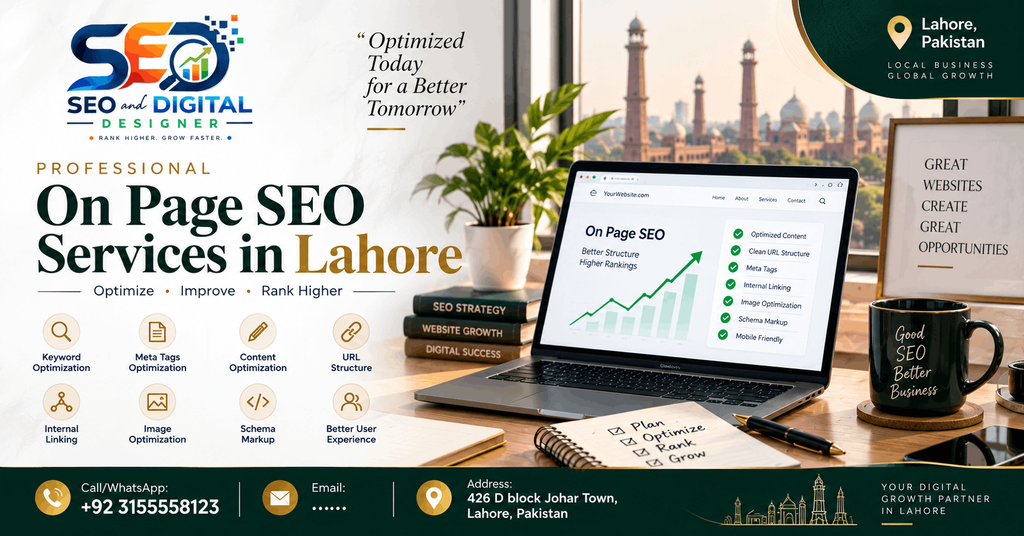
Our On-Page SEO Services
1. On-Page SEO Audit
We begin by analyzing the existing optimization of your website to identify areas that require improvement. The audit can examine:
- Title tags
- Meta descriptions
- Heading hierarchy
- URL structure
- Keyword placement
- Content relevance
- Internal linking
- Image optimization
- Duplicate content
- Indexability
- Page structure
- User experience
The findings provide a practical framework for prioritizing optimization work.
2. Keyword and Search Intent Optimization
Keywords should be selected according to what users are actually trying to accomplish when they perform a search. We analyze relevant queries and classify them according to search intent.
The optimization process considers:
- Primary keywords
- Secondary keywords
- Related terms
- Long-tail queries
- Commercial intent
- Informational intent
- Transactional intent
- Geographic relevance
This creates stronger topical alignment between the webpage and its intended audience.
3. Meta Title Optimization
The title tag is an important page-level element that communicates the primary topic of a webpage. We create concise, relevant titles that accurately represent page content while incorporating appropriate search terminology.
A properly structured title should be useful to both search engines and users rather than being written solely for keyword placement.
4. Meta Description Optimization
Meta descriptions provide users with additional context about a webpage in search results. We optimize descriptions around relevance, clarity, user intent, and appropriate calls to action.
The description should accurately represent the page and encourage qualified users to investigate the content.
5. Heading Structure Optimization
A logical heading hierarchy improves content organization and makes pages easier to understand. We review H1, H2, H3, and other relevant headings to ensure that they establish a meaningful information structure.
Proper heading organization can also make lengthy service pages and articles easier for visitors to scan.
6. Content Optimization
Content optimization focuses on relevance, depth, clarity, and search intent. We evaluate existing content and identify opportunities to improve topical coverage without relying on excessive keyword repetition.
Our approach may include:
- Improving topical relevance
- Strengthening introductory sections
- Expanding missing information
- Refining keyword placement
- Improving readability
- Adding relevant supporting topics
- Removing unnecessary repetition
- Strengthening calls to action
7. URL Structure Optimization
SEO-friendly URLs provide a clear indication of page purpose. We review URLs for unnecessary complexity, excessive parameters, unclear wording, and inconsistent structures.
A logical URL system can also make website architecture easier for users and search engines to understand.
8. Internal Linking
Internal links establish relationships between pages and help users navigate related information. We develop contextual internal linking structures that connect service pages, supporting content, categories, and relevant resources.
Effective internal linking can distribute internal authority and strengthen the topical relationships within a website.
9. Image SEO
Images can contribute to both usability and page relevance when properly optimized. Our image optimization process can include:
- Descriptive file names
- Relevant alt text
- Appropriate image dimensions
- Compression
- Responsive image implementation
- Contextual placement
The goal is to improve accessibility, usability, and overall page efficiency.
10. Schema and Structured Data
Where appropriate, structured data can help communicate specific information about webpage content in a machine-readable format. We evaluate suitable schema opportunities based on the type and purpose of each page.
Implementation should accurately represent the visible information and comply with applicable search-engine guidelines.
11. Mobile and User Experience Optimization
Search optimization should work alongside a positive user experience. We evaluate page layouts, readability, navigation, mobile presentation, calls to action, and content accessibility.
A page that is technically optimized but difficult to use can still create friction for visitors.
12. Content Hierarchy and Semantic Optimization
Modern on-page optimization requires understanding relationships between concepts rather than focusing exclusively on individual keywords. We organize related subjects, entities, supporting terms, and contextual information to develop stronger topical coverage.
This helps create content that addresses the broader information needs surrounding a primary topic.
Our On-Page SEO Process
Step 1: Website Assessment
We review the current website structure, page content, metadata, technical elements, and optimization status.
Step 2: Keyword Mapping
Relevant search terms are mapped to appropriate website pages according to intent and topical relevance.
Step 3: Page-Level Optimization
Individual pages are optimized through improvements to titles, descriptions, headings, content, URLs, images, internal links, and other relevant elements.
Step 4: Technical Validation
Implemented changes are reviewed to identify technical inconsistencies, indexing concerns, broken elements, or structural issues.
Step 5: User Experience Review
Pages are assessed from the visitor’s perspective to ensure that optimization does not compromise clarity, usability, or conversion pathways.
Step 6: Performance Monitoring
Organic visibility, impressions, clicks, landing-page performance, and other relevant indicators can be monitored to evaluate ongoing performance.
Benefits of Professional On-Page SEO
A structured on-page strategy can help businesses:
- Improve topical relevance
- Strengthen website structure
- Increase search visibility
- Improve content organization
- Support better user experience
- Strengthen internal page relationships
- Improve search-result presentation
- Attract more relevant organic visitors
- Create stronger foundations for long-term SEO
Results depend on numerous factors, including website quality, industry competition, search demand, technical health, content depth, and ongoing optimization.
On-Page SEO for Lahore Businesses
Businesses targeting Lahore need webpages that clearly communicate their services and geographic relevance. Location-specific optimization can help establish stronger connections between service offerings and searches involving Lahore.
A localized strategy may incorporate relevant geographic terminology, service-area information, locally meaningful content, and optimized landing pages. However, location terms should be used naturally and only where they accurately represent the business and its services.
Why Choose SEO and Digital Designer, Lahore?
At SEO and Digital Designer, Lahore, our on-page approach combines keyword analysis, content strategy, technical understanding, website structure, and user experience. Each optimization decision is made in relation to the purpose of the webpage and the expectations of its intended audience.
Rather than treating on-page SEO as simple keyword insertion, we consider the complete page ecosystem—from metadata and headings to content hierarchy, internal linking, images, URLs, and conversion elements.
Conclusion
Effective on-page optimization creates a strong connection between website content, search intent, technical structure, and user experience. Professional On Page SEO Services in Lahore from SEO and Digital Designer, Lahore provide a structured approach to optimizing titles, descriptions, headings, content, URLs, images, internal links, structured data, and other important page elements for businesses targeting Lahore.
FAQs
1. What is included in professional on-page SEO?
Professional on-page SEO can include keyword mapping, search-intent analysis, title and meta-description optimization, headings, content optimization, URL structure, internal linking, image SEO, structured data, and user-experience improvements.
2. How is on-page SEO different from technical SEO?
On-page SEO primarily focuses on elements and content associated with individual webpages, while technical SEO addresses broader website infrastructure such as crawling, indexing, site architecture, performance, redirects, and technical accessibility. The two areas often overlap and should work together.
3. How does keyword mapping improve website optimization?
Keyword mapping assigns relevant search terms to appropriate webpages according to search intent and topic. This helps prevent unnecessary overlap between pages and establishes a clearer topical structure across the website.
4. Can on-page SEO improve conversions?
It can contribute to better conversion performance by making landing pages more relevant, understandable, navigable, and aligned with user intent. However, conversions also depend on factors such as the offer, pricing, trust signals, website usability, and calls to action.
5. How often should on-page SEO be reviewed?
On-page SEO should be reviewed periodically and whenever significant changes are made to website content, structure, services, or target audience. Ongoing performance monitoring can identify pages that require additional optimization as search behavior and business objectives evolve.